Tech Teams Tuesday
The middle of Australian tech is exposed.
Issue #1. Where AI is creating senior seats, where it is cutting the experienced middle, and the layer most exposed right now.
Three market moves that matter, one number from the Index, one team move worth watching, what I am building, and the Building Tech Teams podcast. Every Tuesday, 7am. This is a full issue, so you can see exactly what lands before you subscribe.
First issue
Welcome to Tech Teams Tuesday.
My week is spent inside hiring conversations with Australian CTOs, founders, People Leaders and senior tech talent. I see the roles companies are funding, the titles they are inventing, the layers they are cutting, and the gaps they are figuring out. I also run the AI Jobs Index, my live read on publicly cited AI-linked hiring and workforce reductions in Australia.
Every Tuesday I turn that into a short read on how Australian tech teams are changing: what moved, what it means, and what I would do if I were hiring, leading, or making the next career move.
Here is what lands in your inbox every Tuesday:
- The Moves. Three things that actually moved the Australian market this week. For each, what it means if you lead a team, and what it means if you are a tech professional.
- From the Index. One number from the AI Jobs Index, my live tracker of AI-linked hiring and cuts in Australia.
- Team Move of the Week. One appointment or exit worth watching, and what it signals.
- What I'm Building. I am a recruiter, not an engineer, and that is the point. What I am shipping, or what I have learned, with AI tools right now.
- The Podcast. Building Tech Teams. Weekly guest conversations with the operators actually building Australian tech teams in the age of AI.
This is the useful part of what I see each week.
The Pattern
By today's deadline, APS agencies covered by the plan are expected to have named a senior leader as Chief AI Officer. In the past few months, the big banks have been poaching each other's AI chiefs, and the AI Jobs Index has logged thousands of Australian roles cut with AI named as the reason.
One pattern runs through all of it. Australia is building AI leadership in at the top while squeezing the experienced middle. The new seats are senior and strategic. The roles under pressure are the coordination layers beneath them.
To be clear, this is not middle managers being useless. It is pure coordination getting compressed. The middle that combines judgment, technical context and hands-on ownership is not the exposed one. The middle that only moves work between other people is.
My bet is that the next twelve months will not reward people who simply manage the work. They will reward people who can redesign the work. That is the difference between the middle that gets squeezed and the middle that gets promoted.
If you lead a company, the trend to follow is hiring a senior AI leader, and rethinking the layers below. If you are a tech professional, the leverage is at the senior or technical end. Be the judgment and the hands-on capability the AI still needs, or get close to the AI mandate itself. The squeezed place to stand is coordination without judgment.
The Moves
1. The banks are poaching each other's AI chiefs.
Commonwealth Bank hired its first Chief AI Officer, Ranil Boteju, poaching him out of Lloyds in London where he ran data and AI across a team of more than 2,000. He has done tours at HSBC and Lloyds, and now he is back in Australia. Bloomberg's read on 15 June was blunt: the big banks are racing to fill Chief AI roles, and the talent is jumping straight to rivals. This is no longer a “we need to be doing something with AI, find someone technical” role. It is an executive seat, and the banks are pricing it like one.
you are no longer competing for AI leaders with other tech companies. You are competing with banks and super funds who will pay for the role. If you cannot match the comp, provide more scope and support. Senior AI people are looking for influence over workflow, governance, tooling and capability. And they are asking questions to make sure they are set up for success, with support from above and the budget and team to execute once the plan is in place.
the top AI roles are being filled by internal promotion as well as lateral poaching. Visibility outside your own company is an asset now. Being seen in the media, having an opinion, building a personal brand, these all matter to the career growth of senior AI talent. The people getting these calls are the ones the rest of the market can already name.
2. Covered federal agencies are expected to name a Chief AI Officer by 30 June.
The Australian Public Service set 30 June 2026 as the date every covered agency has a senior leader owning AI. The private market might not copy the public service title exactly, but it will copy the accountability model. Boards and CEOs are already asking: who owns AI here? When the honest answer is that it is spread across tech, data, risk, legal and HR, that's where the new role is created. If no single person can make the call, you do not have an AI strategy. You have an AI committee.
steal the structure. If the public service decided AI leadership needs a named owner with a seat, your company might too. If you are a large business, this role should be included in your hiring roadmap. If you are a startup, scaleup or SMB, having someone accountable and skilled as your AI leader is the move to make. The question might not be whether you need to hire the role. It might be who internally is already doing elements of it, and needs a clear growth path to becoming the AI leader in your company. Senior AI talent is in demand and expensive, and if you can grow talent internally, that can be a big advantage.
this is a positive sign. Companies serious about investing in AI are giving it a seat at the leadership table. The role gets named at the top first, then cascades down, creating more opportunities across the broader AI team. Position yourself for the version of this seat that exists in your industry in twelve months.
3. Immutable rebuilt its team to chase the market.
Immutable became Australia's biggest blockchain-gaming name building Web3 games. This month it stopped building them. It cut 29 roles from game development, outsourced most of the remaining work, and kept only a skeleton in-house team. The company is now pointed at Audience, an AI platform that runs marketing and player acquisition for other game publishers. Co-founder Robbie Ferguson calls it “an AI CMO for games.” The part that matters here is not only the pivot, it is the team. The people who made Immutable what it was, the blockchain game engineers, artists and designers, are not the team it needs to build an AI growth platform. My read: that new shape wants more ML, data, attribution and GTM capability than traditional game development craft. Immutable read where the market was heading and rebuilt its team to match, even though it meant losing the people who got it there. That is the call more leaders are about to face: when the market moves, the thing that has to change with it is your team.
the strongest operators right now read the market and move before they are forced to. Immutable decided its future was not making games but selling an AI growth engine to everyone who does. Moves like this have flow-on effects. They can mean changing your team, and sometimes your core product. The hard truth is that the team that is excellent at what you do today may not be the team for where your company is heading.
a pivot like this is a massive change for everyone inside it. If your value was tied to the old product, you are exposed. If you can carry your craft into the new domain, you keep a seat, and become even more valuable with breadth of skills. If not, building within a company like Immutable puts you in a strong position in the job market. Your skills are more portable than your job title. Always bet on the skills.
From the Index
One read a week from the AI Jobs Index, the live tracker I run at aijobsindex.com.au.
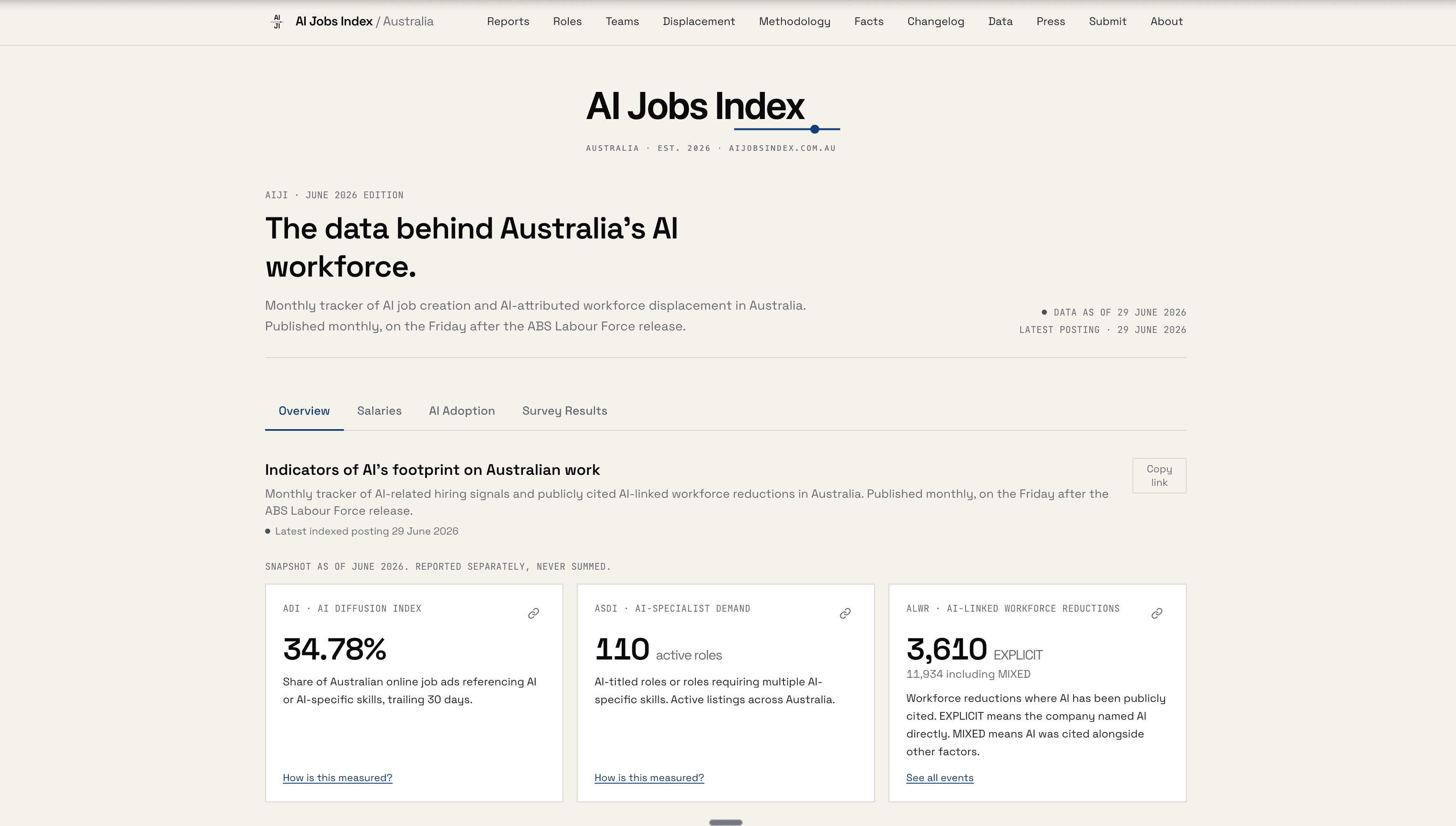
It counts publicly cited AI-linked job cuts in Australia: 3,610 roles where the company named AI directly as the driver, and 11,864 once you add cuts where AI is one of several reasons. The biggest is WiseTech, 30% of its workforce gone, back in February, in what it called an AI-driven restructure, its CEO saying the era of manually writing code as the core act of engineering is over.
The 3,610 number is a floor, not a ceiling. The Index only counts cuts a company attributes out loud, so every quiet restructure that never names AI is missing from the total number. The signal is not that every restructure is AI-driven. The signal is that companies are increasingly willing to name AI as part of the workforce decision.
Team Move of the Week
Commonwealth Bank named its first ever Chief AI Scientist: Professor Mary-Anne Williams, who held the Michael J Crouch Chair for Innovation at UNSW and led its Business AI Lab. The detail that matters: CBA already has a Chief AI Officer, the Ranil Boteju hire from Move 1. So this is not a decision between officer or scientist. It is both.
That is the signal. At the frontier, the AI leadership job is splitting into two senior seats. The Officer owns strategy, governance, adoption and budget. The Scientist leads research, AI security and responsible AI, the harder questions about where the technology is heading and what it does to customers. Williams will run a team of researchers. Most Australian companies are still deciding whether they need one AI leader. CBA just decided it needs two. Watch how far down the market that split travels. Most companies will not fund two senior AI seats, but the Scientist's responsibilities do not disappear. They get deprioritised, or split across the existing team.
What I'm Building
I am a recruiter, not an engineer. That is exactly why this section matters.
If AI tooling only ever helps engineers, most leaders will miss the shift. The bigger change is that operators like me can now build real internal tools, test ideas faster, and understand the technology I'm talking to leaders about on weekly basis. I still believe just because you can build it does not mean you should, I'm not building or maintaining anything with client data. But the leverage is real, especially for leaders of small and medium businesses.
Over the past month I have been building Building Tech Teams. Three things shipped in the past week:
- The AI Jobs Index at aijobsindex.com.au, my live read on publicly cited AI-linked hiring and cuts in Australia.
- The Building Tech Teams site that ties the newsletter, the podcast and the Index together.
- The design system underneath all of it, built from scratch in Claude Design. A senior design team would have taken it further. But I am proud of where it landed, and it means the Index, the site and the socials read as one thing, not three.
I used the same AI tools I think operators need to understand. I'm using AI for strategy, research, gathering data, building products and automations (and more). Where I'm drawing the line is my opinion, I think the human side of communication and taste will only become a bigger differentiator with the growth of AI. I'll share more of my journey each week.
This Week on the Podcast
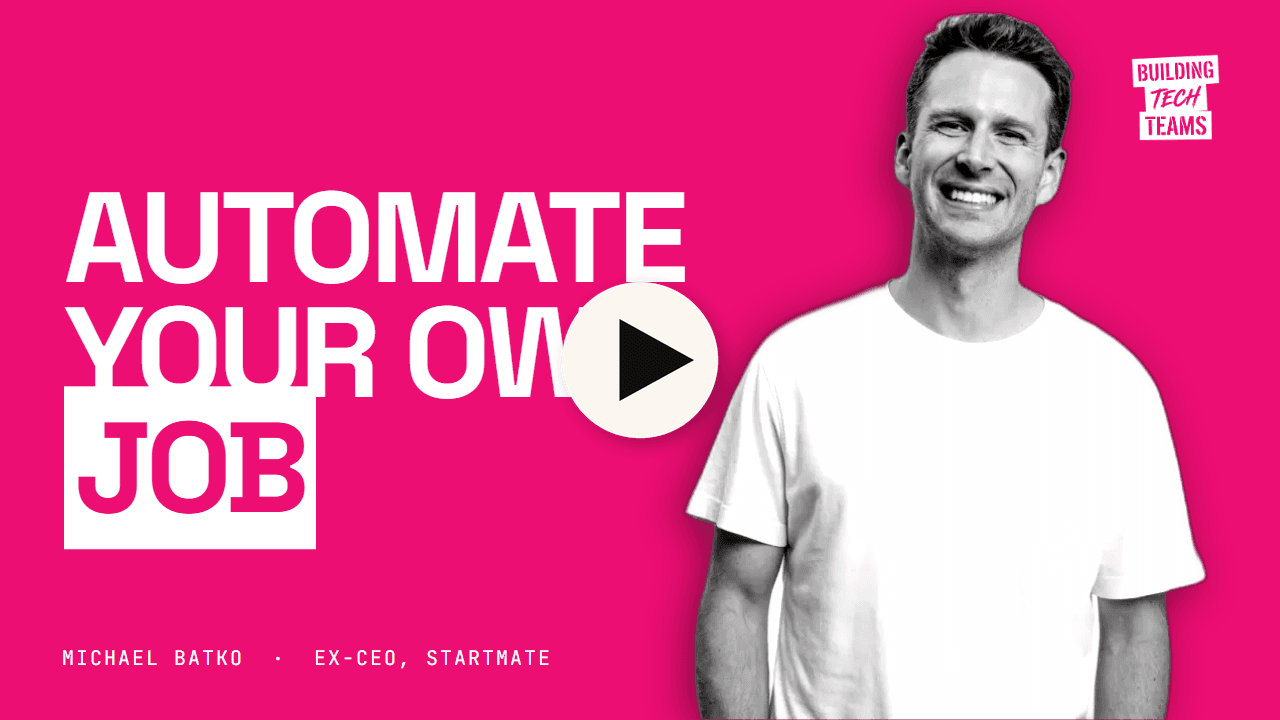
This week on the podcast: Michael Batko, former CEO of Startmate, now building batko.ai (https://batko.ai/) and Hourglass AI (https://thehourglass.ai/).
Batko spent eight years at Startmate watching more than 240 companies make their first hires. Now he works with companies across Australia on introducing AI to their people, processes and operations to improve efficiency and profitability. We get into how the first hire has changed, why the engineer matters more than ever once you are past the first version, and why your experience is the one moat AI cannot copy.
What we get into:
The first hire has flipped from engineer to go-to-market. Building the product is cheap now. The hard part moved to finding customers. Past zero to one, the engineer becomes essential again.
The new unicorn role is the orchestrator. Part architect, part change manager, the person who brings AI tools together across a company. Batko thinks it becomes one of the most important seats in the business, and engineers are best placed to take it.
The product manager to engineer ratio is collapsing. From roughly one PM per five engineers toward one per twenty or thirty, as engineers absorb the PM work. The PM job gets scarcer and more strategic at the same time.
Your experience in life becomes your moat. We get the same AI tools on day one, but the same prompt gives you a different result than the next person. Taste and judgment are the part AI cannot copy.
Why it matters if you are building a team here: Batko has seen more Australian first-hires than almost anyone, and his read is that the shape of the tech team is being redrawn right now. Whether you are staffing the team or deciding your own next move, this one is worth a listen.
The Ask
Hiring for an AI-linked role this quarter and not sure what to call it? Email me the job description, or the messy version in your head. I will send back the wording I would use in the market. I place these roles for a living, and I read every email myself.
Headcount & Code, published as Tech Teams Tuesday until August 2026, is the weekly read from Building Tech Teams, the show on how Australia builds tech teams in the age of AI. Written by James MacDonald, MD of NTP Talent. The AI Jobs Index is a Building Tech Teams publication, supported by NTP Talent.
That was one issue
Get the next one, every week.
Free. Five minutes. For the leaders making the hire and the tech professionals making the move.